The Freeway That Never Got Built Is Still Setting South Pasadena Home Prices
August 13, 2026
August 13, 2026
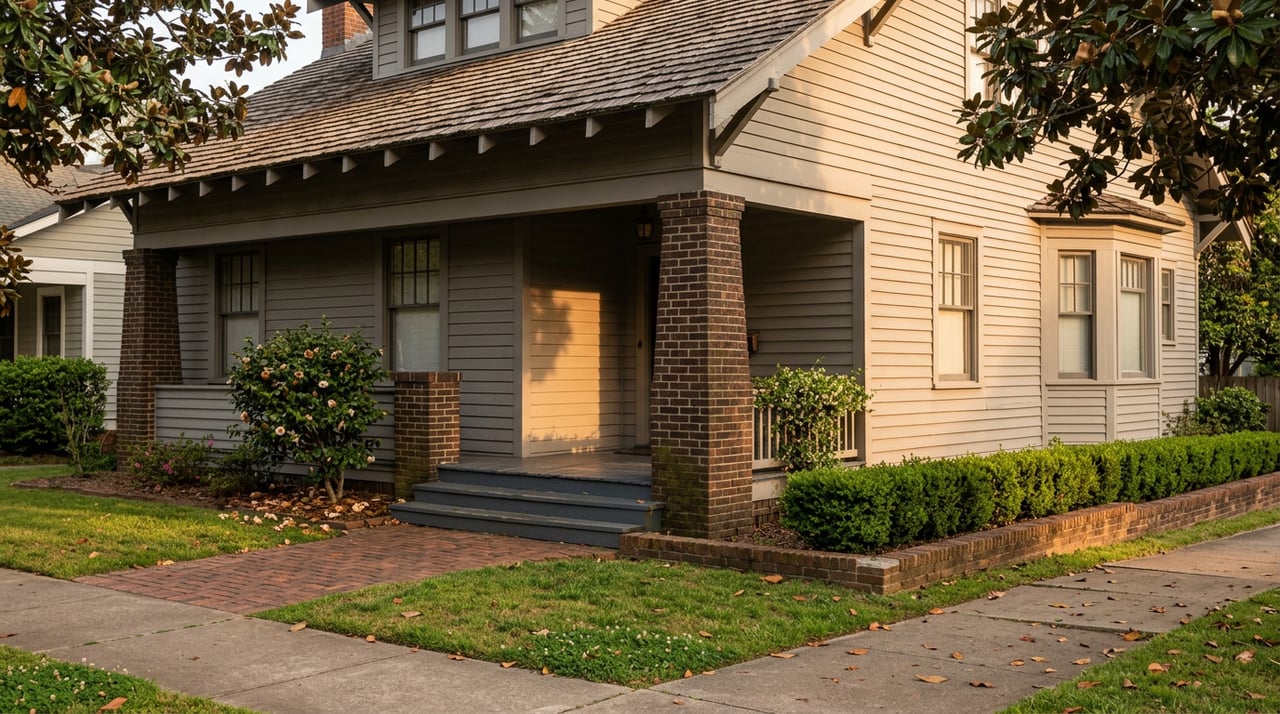
In June 2026, the City of South Pasadena quietly listed eight houses for sale. One of them, the Columbia House at 1131 Columbia Street, is a 1910 Craftsman sitting on the city's own Inventory of Historic Resources. The others sit on Orange Grove Avenue, Bonita Drive, Grevelia Street, Valley View Road, and Prospect Avenue. None of them are new to the market in the way a typical listing is new. Every one of them was purchased decades ago by Caltrans, boarded up or rented out at below-market rates, and held for a freeway that was never built.
That single fact explains more about South Pasadena's housing market today than any median price chart can. If you are comparing this city to Pasadena, Alhambra, or anywhere else in the San Gabriel Valley, the number you should be asking about is not the price. It is the inventory, and the inventory has been shaped by a fifty-year fight that most buyers touring homes today have never heard of.
The 710 Freeway extension was supposed to connect the existing northern terminus of the 710 to the 210 and 134 freeways, closing a gap through El Sereno, South Pasadena, and Pasadena. The routing was set by the California Highway Commission on November 18, 1964. Construction did happen in Pasadena in the early 1970s, where the interchange section known as the Northern Stub displaced at least 4,000 residents and destroyed 1,500 homes, most of them owned or rented by low income and minority families, according to the City of Pasadena's own account of the project.
South Pasadena refused to let the rest of the route through. The city, alongside the Sierra Club, Concerned South West Residents of Pasadena, and the Center for Law in the Public Interest, won a federal injunction in 1973 that froze all construction on the southern stubs and stopped Caltrans from acquiring any more homes until an adequate environmental review was completed, a process that took Caltrans four drafts and twenty-five years to finish, according to reporting from southpasadenan.com. A second injunction in the late 1990s challenged the below-grade tunnel design on historic preservation and environmental grounds, at a project cost then estimated near $1.4 billion for a plan that transportation studies found would move traffic less than one mile an hour faster than building nothing at all.
The freeway was formally killed in October 2019, when Governor Gavin Newsom signed legislation from Senator Anthony Portantino and Assemblymember Chris Holden ending the extension for good. Then-Pasadena Mayor Terry Tornek captured what the decision meant for the region at the time: "It is a new day in Pasadena now that the 710 Freeway is history."
That freeway fight is the reason South Pasadena has almost nowhere left to build. A city that spent five decades resisting a bulldozer through its center also spent five decades protecting its existing housing stock rather than clearing land for anything new. The stub properties are the literal, physical residue of that resistance, and they are still working their way back into private ownership one small batch at a time.
The first batch came through in 2024. On February 7 of that year, the South Pasadena City Council authorized purchase agreements with Caltrans for five long-vacant properties. The California Transportation Commission approved the sale on August 16, 2024, and escrow closed on September 17, 2024, officially handing the homes to the city. When those five properties reached the market, priced from nearly $950,000 to more than $1.2 million according to LAist, CBS Los Angeles reported that the homes would likely not qualify for conventional financing because utilities had been shut off for years. One of the five was not a single home at all but a multi-family lot with three separate bungalows on it.
The eight properties listed in June 2026, including the Columbia House, are the next release from the same backlog. Anyone touring one of these should expect the same friction the 2024 batch carried: dormant utility service, cash-heavy financing, and in the case of a home like Columbia House, historic resource status that can shape what a buyer is allowed to change.
South Pasadena is a small city, roughly 3.4 square miles, and the freeway fight is the reason that scarcity translates directly into price behavior rather than getting absorbed by new construction the way it would in a larger city with room to grow.
Real estate data provider PropertyShark counted 45 closed sales across all of South Pasadena in the second quarter of 2026, up 36.4 percent year over year, but that is still a market moving at roughly fifteen sales a month across an entire city. The median sale price for the quarter was $1.9 million, up 10.8 percent year over year, while the median price specifically for single-family houses came in at $2 million with no significant change from a year earlier. Condos, by contrast, sat at $897,000 for the quarter, also essentially flat year over year. Median price per square foot for the quarter was $993, a 7.9 percent increase from a year earlier. For comparison, the median sale price across all of Los Angeles County in the same quarter was $900,000.
Pasadena, just next door and considerably larger in both land area and transaction volume, tells a different story over the same window. Over the three months ending May 2026, Pasadena's median sale price was $1.2 million, down 1.7 percent year over year, with 248 homes sold in May, down from 303 the year before. Zillow's home value index, which tracks a smoothed estimate rather than a raw sale median, put South Pasadena's average home value at $1,721,982 as of June 30, 2026, up 5.2 percent over the past year, against Pasadena's average of $1,213,522, down 0.4 percent over the same period.
| Market (period ending) | Median or average value | Year-over-year change |
|---|---|---|
| South Pasadena, all sales, Q2 2026 | $1.9M median | +10.8% |
| South Pasadena, houses only, Q2 2026 | $2.0M median | No significant change |
| South Pasadena, condos, Q2 2026 | $897K median | No significant change |
| South Pasadena, ZHVI, as of 6/30/2026 | $1.72M average | +5.2% |
| Pasadena, 3 months ending 5/2026 | $1.2M median | -1.7% |
| Pasadena, ZHVI, as of 6/30/2026 | $1.21M average | -0.4% |
The gap between South Pasadena's house median and its condo median is worth sitting with. In a market this small, a single luxury sale or a single condo closing can pull the blended number in either direction within a quarter. That is exactly why the city's overall figures moved less than its house-only figures this quarter. The freeway fight preserved the housing stock but did nothing to add units, so any buyer comparing South Pasadena's price to a larger city next door is really comparing a market with almost no room to build against one that still has some.
For a buyer weighing South Pasadena against Pasadena, Alhambra, or another San Gabriel Valley city, the practical takeaway is not that South Pasadena is simply more expensive. It is that South Pasadena's supply constraint is structural rather than cyclical. Pasadena's median softened over the past year in part because it has more transaction volume to soften with, nearly 250 sales in a single month compared to South Pasadena's low double digits. South Pasadena does not have that cushion, and the freeway fight is the reason it never will. Waiting for a broader regional cooldown to reach South Pasadena the same way it reaches a larger neighboring city is a bet against fifty years of local history.
For anyone specifically drawn to one of the remaining ex-Caltrans stub properties, the calculus is different again. These homes carry real upside, historic character, protected architectural stock, and prices that can undercut the surrounding market, but they also carry friction that a standard resale does not: dormant utilities, financing that may need to start as cash or a renovation loan, and in cases like Columbia House, historic designation that limits exterior changes. Anyone touring one of these should budget for a utility reconnection assessment and a conversation with a lender about renovation financing before making an offer.
South Pasadena rewards buyers and sellers who understand why its market behaves the way it does, not just what the number on a listing says this month. Whether you are comparing this city to its neighbors or looking specifically at one of the properties still working its way out of the Caltrans backlog, the pricing conversation and the financing conversation are two different conversations, and getting them right from the start matters more here than in a larger, higher-volume market.
The Kinkade Group works across South Pasadena, Pasadena, and the surrounding Northeast Los Angeles cities every week, and we can walk you through what a property's history means for financing, timeline, and long-term value before you write an offer. Schedule your personalized market consultation and let's look at what you're actually buying, not just what the median says you're buying.
Stay up to date on the latest real estate trends.
I am committed to guiding you every step of the way—whether you're buying a home, selling a property, or securing a mortgage. Whatever your needs, I've got you covered.
THE KINKADE GROUP | CA DRE# 01811027
680 E. Colorado Blvd #400 Pasadena, CA 91101